

1
Define the journey
Name what the group is reflecting on. It might be the last sprint, a project phase, a product launch, or progress toward a strategic goal.
Activity preview
Product launch retrospective
A product team reflects on the forces shaping its journey toward a reliable public launch.
A Sailboat Retrospective is a visual reflection activity that helps a team examine its progress toward a goal.
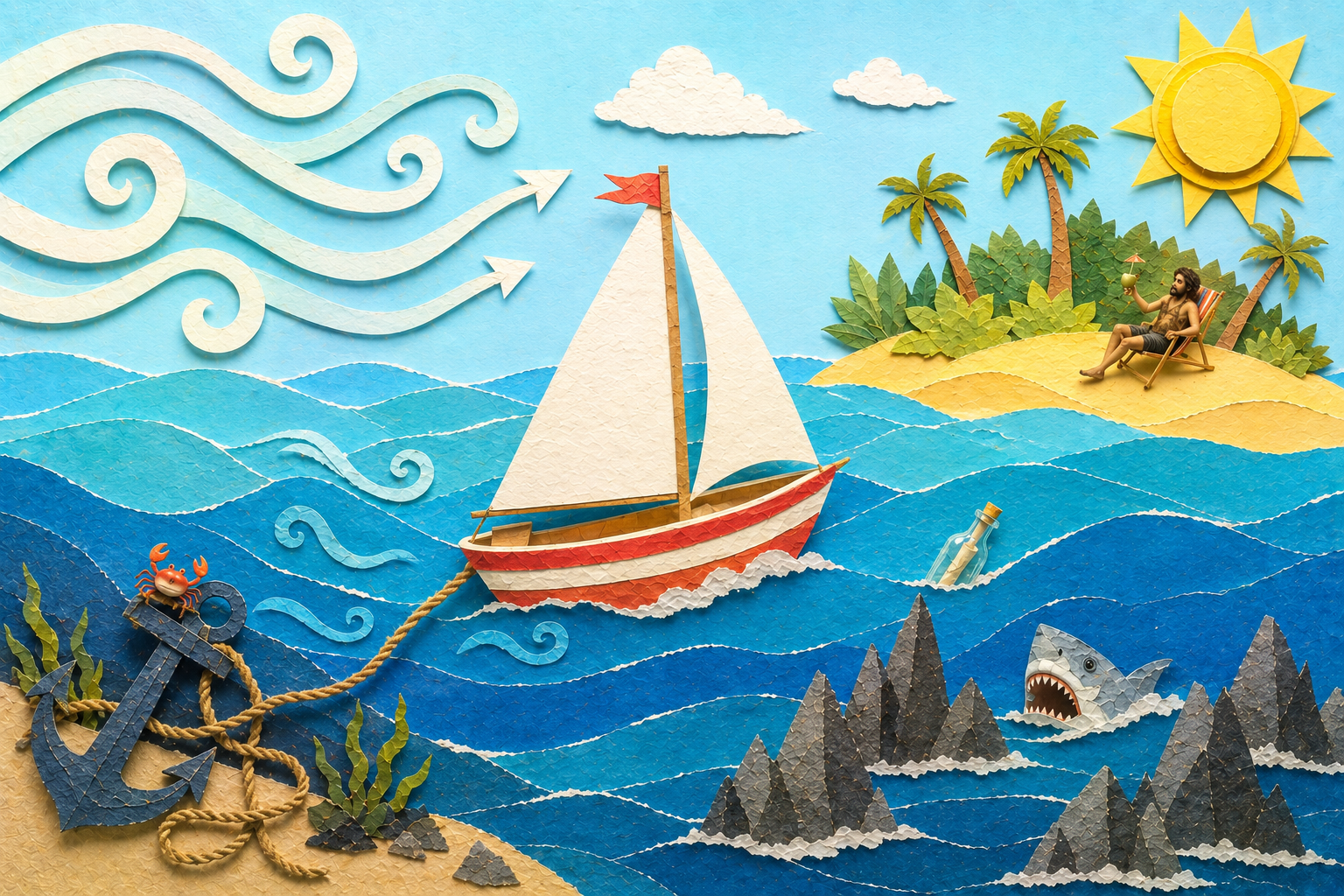
The team imagines itself as the crew of a sailboat. An island represents the destination. Wind helps the boat move. Anchors slow it down. Rocks represent dangers ahead.
These four parts turn a broad question such as "How did the sprint go?" into a more varied conversation:
The image gives people a small imaginative detour. Instead of listing positives and negatives directly, participants think about the work through movement, drag, danger, and destination. That change of frame can surface ideas a Stop / Keep / Start Retrospective would leave hidden.
Research on visual metaphors in graphic facilitation describes how metaphors help people view situations in a new light, make abstract subjects concrete, and build memorable shared reference points. That broader research supports metaphor as a facilitation frame, although it doesn't prove that Sailboat will produce better answers for every group.
The modern Sailboat Retrospective grew from Luke Hohmann's Speed Boat Innovation Game. His original activity was designed for customer understanding: the boat represented a product or system, while anchors represented features, frustrations, or problems holding customers back. Participants wrote their anchors, explained what was causing pain, and could prioritize which anchors would have the greatest impact if removed.
I know Luke and have spoken with him many times, and in 2013 I attended his Certified Innovation Games for Customer Understanding training in London. One piece of his advice has stayed with me ever since: understand each concern before defending the product or rushing into solutions. You'll find that principle echoed throughout this guide, because it applies to the retrospective version just as much as to the original game.
Agile facilitators later expanded the image into the Sailboat Retrospective used today. Wind brought in the forces helping the team. Rocks introduced future risks. The Island made the destination visible. The Agile Retrospective Resource Wiki describes the idea as starting with Hohmann and then being modified by the community over time.
Use a Sailboat Retrospective when a group needs to reflect on recent work while keeping a future goal in view.
It works well for:
The activity is especially useful when the team needs to separate current blockers from future risks. Anchors describe what is already creating drag. Rocks describe what may cause trouble next.
Choose another format when the metaphor doesn't fit the group or topic. A playful visual exercise can feel out of place during a serious conflict, a sensitive incident review, or a conversation where people first need stronger psychological safety.
The boat represents the team, project, or shared effort, and it gives the other elements a common context. Most templates treat it as scenery: the four questions cover Wind, Anchors, Rocks, and Island, and the boat simply sets the scene.
Nothing stops you from using the boat as a fifth question. Ask about the crew, the state of the vessel, or what is happening on board when the group would benefit from reflecting on itself.
The island is the destination: a sprint goal, a project outcome, a team ambition, a customer result, or a better way of working.
Everything else in the exercise depends on it. Wind toward what? Drag on which journey? A vague destination weakens every other prompt, so clarify what journey the group is discussing before asking about wind, anchors, and rocks.
Wind stands for the forces pushing the group forward. Useful habits, supportive people, good decisions, effective tools, clear communication, favorable conditions.
Teams often treat this area as a quick round of celebration and move on. That wastes it. Ask what the team should protect, repeat, or strengthen, because wind that nobody tends to has a way of dying down.
Anchors are the blockers and sources of friction already slowing progress. Dependencies, unclear ownership, recurring delays, difficult processes, missing skills, habits the team could change.
The test for a good anchor card: does it describe a current source of drag on this specific journey? A general complaint with no connection to the destination belongs somewhere else.
Rocks are the risks and threats that may damage future progress. They push the team to look ahead instead of only reviewing what has already happened.
Keep rocks distinct from anchors. An unresolved dependency affecting the team today is an anchor. A supplier change that may affect the next release is a rock.
A typical session takes 30 to 60 minutes. Adjust the depth to the size of the group and the importance of the journey.
Name what the group is reflecting on. It might be the last sprint, a project phase, a product launch, or progress toward a strategic goal.
Introduce Wind, Anchors, Rocks, and Island. Give one short example for each prompt so participants understand the difference between them, then stop explaining. The metaphor should support thinking; too much setup turns it into a puzzle to decode.
The questions don't have to be answered in one fixed order.
You can:
The order is part of the facilitation design. Choose it according to the group, context, and available time.
Ask participants to reflect individually before discussion begins. Quiet writing gives everyone space to form an opinion before the first speaker influences the room.
Ask for one observation per card. Specific cards are easier to understand, group, and act on.
Let participants place their cards in the relevant areas. Avoid debating every contribution as soon as it appears; premature discussion narrows the range of ideas.
If a card could belong in two areas, let the participant choose its primary meaning. The group can clarify it during the debrief.
Review the cards with the group. Ask contributors to explain ambiguous wording. Look for patterns without rushing to solutions.
When reviewing anchors, resist the urge to defend the current system or explain why a problem exists. First understand how the anchor affects the team's progress.
Bring similar contributions together and name the themes. Keep important minority observations visible even when they don't form a large cluster. At this point, feel free to reorganize the cards outside the sailboat picture if another arrangement makes the patterns easier to see.
Choose the anchors, rocks, or opportunities that deserve action. Voting can help when the group has many candidates, but only after everyone understands the cards.
Finish with a small number of concrete actions, each with an owner and a moment when the team will check the result.
A useful debrief moves through three levels.
Ask:
Ask:
Ask:
The completed picture is an intermediate artifact. The value comes from the conversation and the decisions that follow.
A clear Island gives meaning to every other prompt. Name the sprint goal, project outcome, team ambition, or change the group is trying to reach.
Participants who receive one example per prompt tend to start writing. Participants who receive five minutes of metaphor theory tend to worry about placing their cards "correctly."
Anchors create drag now. Rocks represent danger ahead. If a card could fit both, ask what the participant most wants the group to notice.
A few minutes of individual writing before any discussion produces a wider spread of observations than an open conversation where the loudest voice sets the theme.
Understand the frustration behind an anchor before defending the current process or proposing a fix. Clarification creates a better basis for action.
The boat picture earns its keep during collection. For clustering, participant-by-participant review, or voting, another arrangement of the same cards often serves the group better.
Voting helps with prioritization, but only after the group understands the contributions and themes. A ranked list of ambiguous cards is a decision in appearance only.
Choose a small number of actions. Give each one an owner and a date when the team will review what happened.
Teams run retrospectives regularly. Repeating the same questions and format can make the session predictable: participants return to familiar answers instead of examining the work again. This is also why experienced practitioners recommend rotating retrospective techniques to keep conversations fresh.
Change the angle when the current format has become stale. A Sailboat Retrospective can refresh a team that usually uses direct columns, and later another metaphor or question set may be more useful in turn.
Choose variety with purpose, though. A new picture can't repair missing trust, defensive leadership, or repeated failure to complete retrospective actions. The facilitator still needs to create safety, guide a useful discussion, and close the feedback loop.
A polished sailboat is unnecessary. Use a clear image, explain the symbols, and move quickly into reflection.
Separate current drag from future danger. This distinction helps the team decide whether to remove an active blocker or prepare for a risk.
Wind, anchors, and rocks only make sense in relation to a journey. Define the scope and destination before collecting ideas.
Let participants generate cards before the group debates them. Once a debate starts, later contributors write toward it.
A full sailboat is a starting point. The retrospective still needs clarification, prioritization, and action.
A quick vote on unclear cards creates a ranking without shared meaning. Clarify and group first.
Even a creative format becomes routine through repetition. Keep several retrospective approaches available and match them to the purpose of the session.
Clarify the Island first. Then ask what provides Wind, what creates Anchors, and which Rocks lie ahead. This works well when the team has lost sight of its goal.
Begin with strengths and helpful conditions before discussing blockers and risks. This can create a constructive tone for a group that tends to focus immediately on problems.
Reveal one prompt at a time. Sequential collection helps participants concentrate and lets the facilitator allocate different amounts of time to each question.
Use the activity before a project or difficult phase. Define the destination, identify expected support, anticipate drag, and map risks before they happen.
Use the narrower form associated with Luke Hohmann's original Speed Boat Innovation Game. Focus only on the boat and the anchors holding it back. This variation works when the main purpose is to understand and prioritize sources of frustration.
You can run a Sailboat Retrospective on any shared surface that can hold the visual scene and participant contributions. The setup should make the four prompts clear and leave enough room to group or move cards during the debrief.
For an in-person session, draw the boat, Island, Wind, Anchors, and Rocks on a whiteboard or large sheet of paper. Use one sticky note per observation. A rough drawing is enough.
For remote or hybrid groups, use a shared document, slides, a generic online whiteboard, or another collaborative board. Prepare the four areas before the session and decide whether participants will see every prompt at once or move through them sequentially.
The low-tech version works well for collection and discussion. Larger groups may need more support for reorganizing contributions, changing the review perspective, and running a fair vote.
The Stormz Sailboat Retrospective preset provides four guided areas:
Participants add one observation per card in the Metaphor view. The visual surface supports collection, while the same cards can be reviewed differently afterward.
The facilitator can switch to the Kanban view or Table for a more structured review. Cards can also be grouped by participant, explored through the Word Cloud view, or shown in random order when the group needs to reduce ordering bias.
Voting is optional and starts as a separate facilitation step. Once a voting session exists, the facilitator can choose Random order before participants prioritize the cards.
This flexibility supports the principle behind the whole activity: collect with the view that stimulates reflection, then debrief with the view that best supports the next conversation.
Time. An anchor is slowing the team down today; a rock may hurt the team tomorrow. A dependency blocking the current sprint is an anchor, while a reorganization announced for next quarter is a rock. Keeping them separate helps the team distinguish problem solving from risk preparation.
There is no mandatory order, so treat the sequence as a facilitation choice. A team that has drifted from its goal benefits from Island first. A group of habitual complainers benefits from Wind first. When time is short, open everything at once.
No. The vocabulary comes from agile practice, but the underlying questions (goal, helpful forces, current blockers, future risks) apply to leadership groups, project teams, trainers, and workshop participants of any kind.
Yes, and for a co-located team a whiteboard and sticky notes may even be the better choice. A digital tool starts to pay off with remote or hybrid participation, groups above roughly a dozen people, or a debrief that needs regrouping, alternative views, and voting.
Use it when its visual frame fits the purpose. A reasonable rhythm for many teams is to rotate two or three formats and bring Sailboat back every few cycles. If the team starts answering automatically, that is the signal to switch.