

How to Design a Workshop, Step by Step

Workshop design is simple. It's just a recursive black box decomposition process.
What?
Yeah, I know. That's what comes out of my mouth when I forget I'm not talking to my old Six Sigma friends. Let me try again, like a normal person.
The whole idea is this: don't look inside the box until you're allowed to.
By the end of this article, you'll have designed a workshop with me. We'll build a real one together as we go: a one-hour retrospective for a team that just finished a sprint.
First, one concept: a workshop is a process
A process is a sequence of steps. Each step takes something in and produces something out. Making coffee is a process: beans and water go in, coffee comes out, and in between there are steps, grind, brew, pour, each with its own in and out.
A workshop is exactly that. People come in with something, in a certain state. They leave with something else. And in between: steps.
Now, when you describe a process, you don't start by listing 270 tiny steps. You start with one big step. You decide what goes in and what comes out of it. Then you cut it into a few smaller steps, decide what goes in and out of each of those, and you keep going like that, level by level, until you have the detail you need.
That's the whole method. Each step, at every level, is what I call a box: you define what enters and what leaves, and you keep what happens inside closed until it's time. Engineers design everything this way. I spent years doing it, and all I did was bring the habit into workshop design.
Step 1: Draw the box. Don't open it.
Your whole workshop is the first box, the big one. Something goes in. Something comes out. That's all you're allowed to define right now.
Ask yourself one question: what walks into the room, and what must walk out?
Time to start on our example, the sprint retrospective. What walks in is a team where everyone has their own private opinion about how the sprint went, and nobody has heard anyone else's. What must walk out is a short list of actions the team actually commits to. Around the box, the constraints: one hour, in person.
That's it. That's the box.
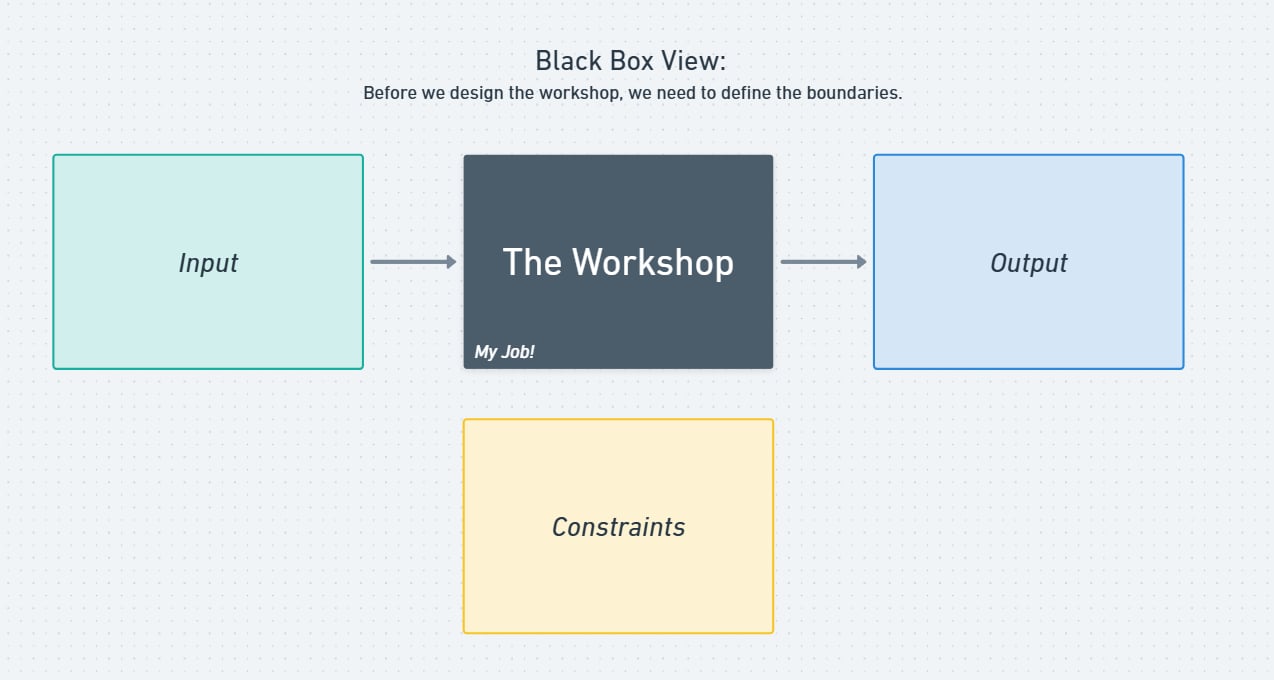
Right now, your brain is already whispering activity ideas. "Ooh, we could do that thing with the sticky notes." Stop. This is exactly the mistake this whole method exists to prevent.
I get calls from clients who already know they want a World Café. They've seen one, they loved the energy, people moving between tables. And I get it, it's a great format. But that's like picking a car because you like the color. First you figure out how you'll use it: city traffic every day, or the countryside once a year? Then you pick the car.
Step 2: Split the box into more boxes. Still don't open them.
Now open the box just a crack. Cut your workshop into a few smaller boxes, three to five of them. Each one gets the same treatment: what goes in, what comes out. Nothing about how.
Always include an Opening box and a Closing box. People don't walk in ready, and they shouldn't just stop and leave.
For each box, ask yourself: what's true about the group at the end of this box that wasn't true at the start?
Our retro becomes three boxes:
- Opening. In: a team that doesn't know yet why they're here, or how honest they can safely be. Out: a team that gets the point of the session and feels safe speaking up. Roughly 5 minutes.
- Retro. In: everyone's private experience of the sprint. Out: that experience turned into a written, committed list of actions. Roughly 45 minutes.
- Closing. In: those actions. Out: a team that leaves feeling the hour was worth it. Roughly 10 minutes.
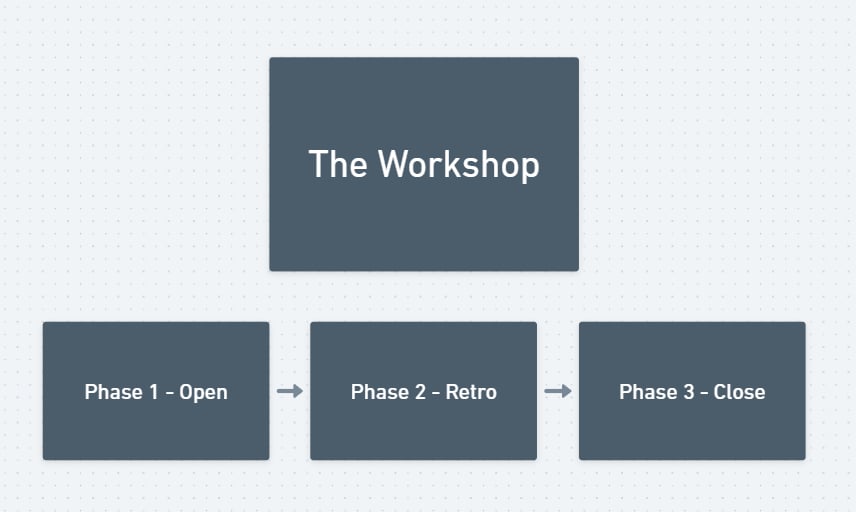
Notice the timing: rough blocks, no precision. "Roughly 45 minutes" is all you're allowed to say right now. The minute-by-minute schedule comes much later.
Step 3: Test each box. Can you give it one label?
Here's a little test that tells you when a box needs to be split further.
There are three things a group can do with ideas:
- Diverge: make more of them. Generate, collect, imagine.
- Emerge: keep the same amount, but understand it. Organize, share, see the patterns.
- Converge: end up with fewer. Choose, vote, decide.
Now try to put one of these three labels on each of your boxes. One label: the box is done. Two or more labels: it's not one box, it's several. Split it. Opening and Closing boxes are excused from the test, they're bookends, they do their own thing.
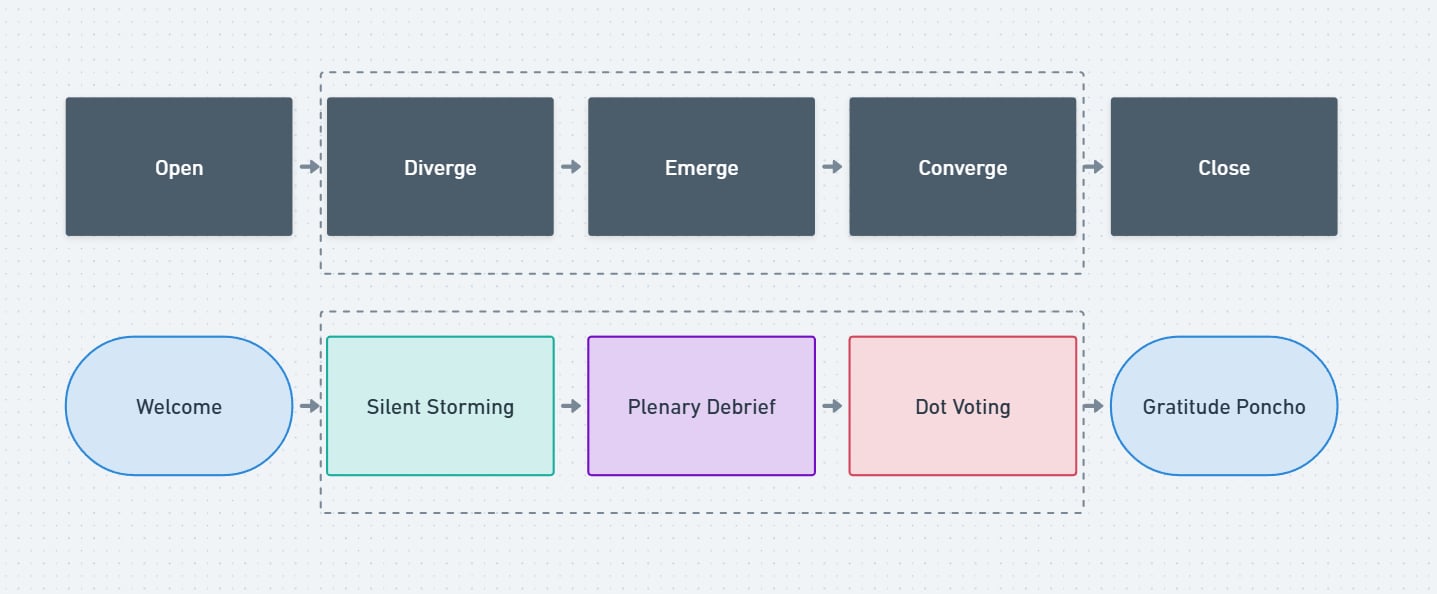
Our retro box fails the test beautifully. People need to get their ideas out (diverge), hear everyone else's (emerge), and pick a few actions (converge). Three labels. So it splits into three boxes:
- Diverge. In: everyone's private observations. Out: everything on the table, unfiltered.
- Emerge. In: that big pile. Out: the same pile, but now everyone has seen all of it and the big themes are visible.
- Converge. In: the themes. Out: 3 to 5 actions, each with an owner and a date.
Step 4: Now pick activities. Expect to try a few.
Finally. This is the moment you've been holding back for. Every box gets an activity.
For each one, ask yourself: does this activity produce what this box needs to produce, or do I just like it?
Here's what I'd pick for our retro:
- Opening gets a simple Welcome.
- Diverge gets what I call Silent Storming: everyone writes alone, in silence, using Stop-Keep-Start as the structure. Why silent? Because quiet people put their ideas on paper before the loudest voice in the room takes over.
- Emerge gets a Plenary Debrief: everyone reads their list out loud. Nothing gets sorted, nothing gets merged. Just hearing all the lists is enough, the big themes show up on their own.
- Converge gets Dot Voting, and each winning action gets an owner and a date on the spot.
- Closing gets a Gratitude Poncho: everyone writes what they appreciate about a colleague on a flipchart sheet folded into a poncho. People wear them out the door. Yes, it's silly. It works.
None of these choices are sacred. Ten other activities could fill each box just as well. That's the point: once the box is clear, the activity is easy to swap.
And if you try an activity and it doesn't produce what the box needs, try another one. If nothing works, the problem is probably the box itself: wrong input, fuzzy output, or just too big. Redraw it. That's normal. That's the process working, not failing.
Step 5: Lock everything.
Now, and only now, everything gets precise. Instructions get written. Materials get made. And the rough time blocks turn into a real schedule: 9:00 Welcome. 9:05 Silent Storming. 9:15 Plenary Debrief. 9:28 Dot Voting. 9:38 Gratitude Poncho. 9:48, out the door.
Writing "9:15 to 9:28" back in Step 2 would have been the same mistake as picking the sticky notes in Step 1: answering a question way before you'd earned the answer.
That's the whole method
Draw the box. Split it. Test each piece with one label. Pick activities last. Lock it all down.
One honest warning: our retro was a deliberately easy example. Real workshops have more boxes, more failed attempts, more redrawing. The mechanics stay exactly the same, there's just more of it.
Next up, I'll go deep on the step that causes the most damage when it's rushed: the very first meeting with your client, where the big box gets drawn. If you've ever had a workshop go wrong and couldn't say why, chances are it went wrong there, weeks before anyone walked into the room.
Aside for the geeks
If the box thing tickled your engineering brain, here's where it comes from, and where to dig deeper.
IDEF0. The most direct ancestor. A functional modeling standard where an entire system starts as one single box with arrows for inputs, outputs, controls and mechanisms, then gets decomposed into child diagrams, each still a box with the same arrow logic, level by level. That's the recursive decomposition this whole article runs on. Born from SADT, standardized by NIST as FIPS-183.
SIPOC. Six Sigma's version of Step 1. Before improving a process, you map its Suppliers, Inputs, Process, Outputs and Customers on one line, deliberately staying out of the detailed steps. It's a scope-level black box, and it's drawn during the Define phase for exactly the reason we draw the big box first: agree on the boundaries before anyone falls in love with a solution. ASQ has a concise overview.
Divergent and convergent thinking. These come from Creative Problem Solving, developed by Alex Osborn (the man who coined "brainstorming") and Sidney Parnes in the 1940s and 50s. Sam Kaner later adapted the idea for group facilitation in his Diamond of Participation, adding the honest observation that the middle of the diamond is uncomfortable, his famous "Groan Zone." My emerge label sits in that middle, with a simpler test: diverge makes more alternatives, converge makes fewer, emerge keeps the count and builds understanding.
Progressive elaboration. Project managers' name for what we did with timing: commit to detail only as the work earns it. Rough blocks first, minutes later. The same logic agile teams apply when they refuse to specify sprint 12 in week one. Rolling wave planning applies the same principle.
None of these fields invented workshops. But they all learned, each in their own way, the same lesson this article is built on: define what a thing must do before deciding how it does it.
Signal rituals: a field guide to workshop objects
A practical field guide to using small objects as shared signals for courage, drift, pacing, and unspoken tensions in workshops.
How to Make Training and Workshops Fun (Without Losing the Plot)
Nine practical levers for making training and workshops more fun while keeping every activity tied to the outcome.